
The bride’s outfit is planned for a year. The groom’s is sorted eventually. And somewhere around week three of the final month, someone says: what are the mums wearing?
It’s a strange gap, because if you look at the photographs afterwards, the mothers are in an enormous proportion of them. Doli. Milni. Every group shot. The moment on the ceremony steps that ends up framed in the hallway for the next thirty years.
So it’s worth more than a rushed Saturday in Southall. Here’s how to think about it.
Start with the brief, not the outfit
Your day looks like this: you’re up before six, you’re on your feet for most of twelve hours, you greet somewhere between two and six hundred people, you cry at least twice, and you do a fair amount of it in a British venue that is either colder or hotter than anyone anticipated.
You also need to be able to hug your daughter properly without worrying about a pin.
An outfit that photographs beautifully and cannot survive that day is the wrong outfit. Every decision below comes back to this.
Coordinating with the bride without matching her
The aim is that the family photographs look considered rather than accidental — and that nobody looks like they’re in uniform.
What works well is sharing one thing and varying the rest. A common metal, so all the gold sits together. Or a shared undertone — everyone in warm shades, everyone in cool ones — with different colours inside that. Or one repeated detail, a border motif or an embroidery style, that carries across the family without being obvious.
What doesn’t work is two mothers in the same colour who didn’t discuss it. Have the conversation. It’s less awkward than the photographs.
Colour, honestly
Most families steer mums away from bridal red and heavy bridal gold, and away from the exact shade the bride is wearing. Beyond that, it depends who you ask, and it’s worth quietly checking your own family’s feelings about white and black before you commit — views differ a great deal by community and generation, and this is not the week to discover that.
What tends to look wonderful on mothers: deep jewel tones — emerald, sapphire, wine, teal — which hold their richness under indoor lighting and against every background. Muted golds, bronze, old rose, ivory with strong embroidery. Anything with a bit of weight to the fabric, because thin synthetics look thin in photographs no matter how good the colour is.
What tends to disappoint: very pale pastels in a dim marquee, and anything with a high-shine synthetic surface, which bounces flash straight back at the camera.
Silhouettes that earn their place
The saree, obviously, and there’s a reason it endures. It’s forgiving through the day, it’s dignified, and a well-draped saree in good fabric outclasses almost anything else in the room. The one thing it demands is a blouse that fits — more on that below.
The anarkali or long kurta with churidar. Currently the most requested option for mums, and deservedly. It’s comfortable, it moves well, it works standing and sitting, and it needs no adjustment across a long day. If you’re not confident in a saree or you simply don’t want to think about the pallu, this is the answer.
The sharara or gharara, particularly for a mehndi or sangeet where you might actually dance. More relaxed, more fun, easier on the legs.
A structured gown or a fusion outfit for the reception, if the venue leans that way. Plenty of mothers wear Indian for the ceremony and something more Western-influenced in the evening, and it reads as intentional rather than inconsistent.
A lehenga, in a lighter, less bridal register. Beautiful on mothers when the skirt is fuller and calmer and the embroidery sits at the border rather than all over.
The blouse is the entire outfit
If you take one thing from this: the blouse decides whether a saree looks extraordinary or merely fine.
It’s the only fitted part. It sits across your shoulders and back in every photograph. And it’s the part most likely to be an afterthought — bought ready-made, roughly your size, altered in a hurry, then tugged at all day.
A blouse made to your measurements changes the whole silhouette. Sleeve length that you’re comfortable in rather than what came with it. An armhole you can lift your arms in — genuinely test this, at the fitting, both arms above your head. A back that fastens securely without gaping. A neckline you’ll be happy with in a photograph taken from an angle you didn’t choose.
If your budget is limited and you’re wearing a saree you already own, spend the money on a new blouse rather than a new saree. It’s the higher-return decision by some distance.
The practical things nobody mentions
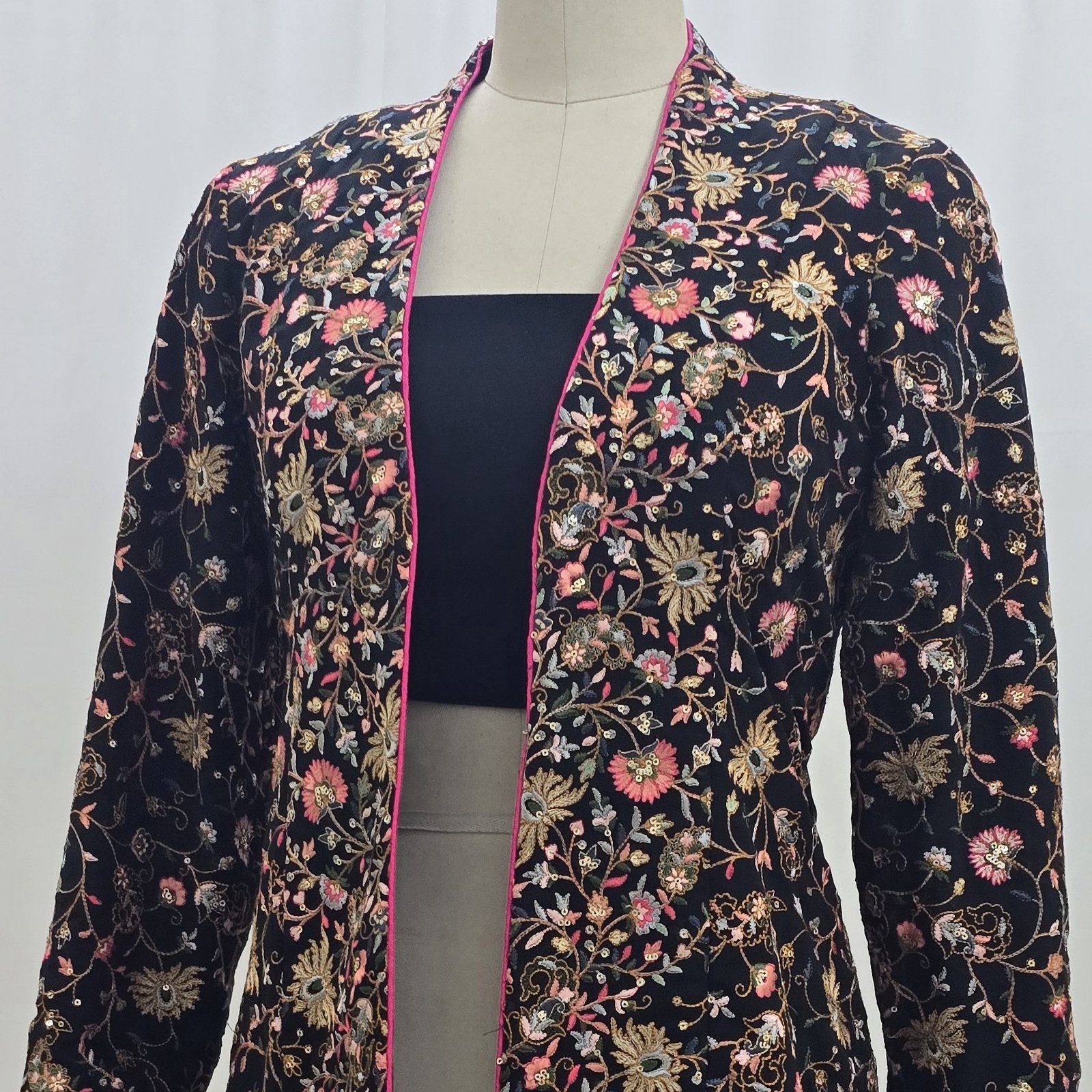
The temperature. A gurdwara at seven in the morning in February is cold. A marquee in July is not. Sleeves you can live with either way, and something elegant to layer — a good shawl, a tailored jacket in a coordinating fabric — is worth planning rather than improvising with a coat.
Head covering. If the ceremony is at a gurdwara or mandir, your dupatta needs to be able to sit on your head and stay there. Some fabrics simply won’t. Test it before the day, not on the morning.
Shoes. Twelve hours. Bring a second pair for the evening and don’t feel remotely bad about it.
Pinning. Whatever the outfit, have someone show you how it’s secured and do it once at home. There is no worse time to learn than fifteen minutes before the milni.
Pockets, or a plan for the absence of them. Someone has to hold the tissues, the lipstick, and the envelope for the pandit.
How many outfits do you actually need?
For a full multi-day UK wedding, most mothers end up with three or four: mehndi or mayian, ceremony, reception, and one spare for whatever additional function gets added in month seven.
They don’t all need to be significant. One outfit carries the weight — usually the ceremony — and the rest can be lighter, simpler, or things you already own refreshed with a new blouse or a different dupatta.
When to start
Three to four months is comfortable for something made to measure. Mothers routinely leave it to six weeks, and it can be done, but the options narrow.
There’s a good argument for going earlier: if the bride’s outfit is being designed anyway, deciding the family palette at the same time is far easier than reverse-engineering it later.
If you’d like something made for you
We make outfits to measure for brides and for the family around them — Indian wedding dresses, sarees and blouses, anarkalis, gowns and fusion wear — alongside bespoke bridal lehengas, from a studio in London.
Mothers and daughters often come to the same appointment, which we’d recommend. Book a consultation and bring your dates.
Also worth reading
- When to start your bridal lehenga: a realistic timeline for UK brides — how long a bespoke outfit really takes, month by month.
- Getting your wedding outfit made in India or in the UK — an honest comparison, including customs and the fitting problem.
